Discover the best easy Grand Canyon hikes for beginners, families, and seniors. Short trails, rim walks, and guided options with minimal elevation gain.
Best Easy Hikes at Grand Canyon
Grand Canyon National Park has a reputation for brutal, dehydrating hikes — and that reputation is mostly earned, if you're talking about the inner canyon. But the easy Grand Canyon hikes near the rim are a different animal entirely. These are short, mostly flat, well-maintained trails that let you stand at the edge of one of the planet's biggest holes in the ground without needing hiking poles, altitude training, or a satellite beacon.
The two trails that matter most for beginners are the Rim Trail on the South Rim and the first mile or so of either Bright Angel Trail or South Kaibab Trail. Everything else — the full descent to Plateau Point, Indian Garden, or the Colorado River — belongs to a different category of hiker, one prepared for 2,000+ feet of elevation change and a brutal climb back out. Don't confuse the two. Park rangers deal with heat exhaustion cases every season from visitors who hiked down fast and then couldn't get back up.
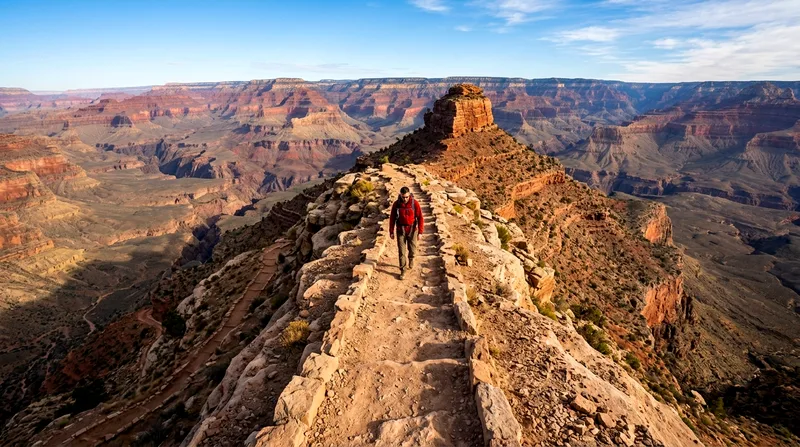
If you're short on time, the Rim Trail alone delivers more canyon panorama per minute of walking than almost any other trail in the park. If you want to feel like you're actually inside the canyon, descending a few switchbacks on South Kaibab to Ooh Aah Point gives you that without serious risk.
The Rim Trail segments stay nearly flat, while even the shortest below-rim routes add real elevation gain on the return climb.
Easy Grand Canyon hikes compared by distance, elevation gain, and difficulty
| Trail | Round-trip distance | Elevation gain | Surface | Best for |
|---|---|---|---|---|
| Rim Trail (Mather to Yavapai Point) | approx. 1 mile | Minimal | Paved | Strollers, wheelchairs, seniors |
| Rim Trail (Hermits Rest Route) | Varies, 1-8 miles | Minimal | Paved | Quieter viewpoints, shuttle access |
| Bright Angel to first tunnel | approx. 1 mile | approx. 200 ft | Dirt/gravel switchbacks | First-timers testing below-rim hiking |
| Bright Angel to Mile-and-a-Half Resthouse | approx. 3 miles | approx. 1,100 ft | Dirt/gravel switchbacks | Fitter beginners, seasonal water access |
| South Kaibab to Ooh Aah Point | approx. 1.8 miles | approx. 600 ft | Exposed, steep, no water | Best views for least distance |
| Trail of Time | approx. 2 miles | Minimal | Paved | Geology interest, families with kids |
Figures are approximate and widely published; always confirm current trail and water-station conditions at the Visitor Center before hiking.
South Rim vs. North Rim trails
The South Rim is where almost all easy-hike infrastructure lives. It's open year-round, has the paved Rim Trail, shuttle buses, and the trailheads for Bright Angel and South Kaibab. The North Rim, by contrast, closes roughly mid-October through mid-May due to snow, sees a fraction of the visitors, and has fewer graded, beginner-friendly options — its easy trails, like the short walk to Bright Angel Point, are good but limited in number.
For families, seniors, or first-time visitors with limited time, the South Rim is the obvious choice. It's also closer to Phoenix (about 3.5 hours) and Flagstaff (90 minutes), with more lodging and tour options nearby. The North Rim appeals more to repeat visitors or those craving fewer crowds — but if this is your first trip and you want easy, accessible hiking, go South Rim without hesitation.
Difficulty ratings explained
The National Park Service doesn't rate trails the way ski resorts rate runs, but you can read the signs. "Easy" at Grand Canyon generally means under 300 feet of elevation gain, paved or hard-packed surface, and round trips under 3 miles. The moment a trail description mentions "strenuous," switchbacks continuing below the first overlook, or distances past a mile and a half one-way, treat it as intermediate at minimum — regardless of how it's marketed. Compare that to Zion's Riverside Walk, which is similarly flat and paved, or Bryce Canyon's Rim Trail near Sunrise Point — both useful benchmarks if you've hiked those parks before.
Rim Trail: The Gentlest Option
The Rim Trail is the single best answer to "easy Grand Canyon hikes" and it's not close. It runs roughly 13 miles one-way along the South Rim from South Kaibab Trailhead to Hermits Rest, and the vast majority of it is paved and mostly flat, following the canyon edge rather than descending into it. Elevation gain across any given segment is minimal — you're walking along the rim, not down it.
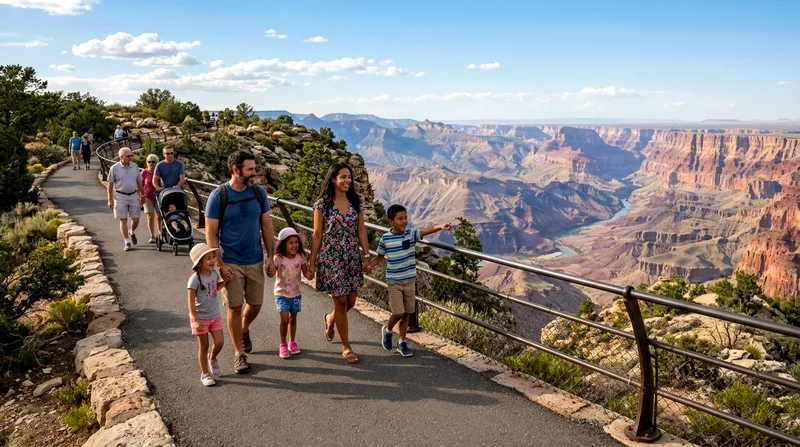
What makes this trail work for almost everyone is flexibility. You don't have to walk all 13 miles. Free shuttle buses stop at viewpoints all along the route (Mather Point, Yavapai Point, Hopi Point, Powell Point, and more), so you can walk one segment, hop a shuttle, walk another, and skip the parts that don't interest you. Wheelchair users and strollers handle the paved sections near the Visitor Center and Village without trouble. I wouldn't recommend attempting the entire 13 miles in one day unless you're training for something — it's long, exposed in places, and the payoff per mile drops off once you've seen four or five viewpoints.
Distance and time options
Realistic segments for beginners: Mather Point to Yavapai Point is about 1 mile round trip and takes 30-40 minutes with photo stops. The stretch through Grand Canyon Village to Trailview Overlook is another easy 1.5-2 miles. For something more immersive, Hermits Rest Route (accessible by shuttle, closed to private cars most of the year) covers quieter viewpoints like Pima Point and Mohave Point with gentle paved walking between stops. Budget roughly 20 minutes per mile if you're stopping often for views and photos — which you will.
Accessibility and parking
Parking fills fast at Grand Canyon Village and the South Kaibab Trailhead by mid-morning, especially between May and September. Your best bet is parking once near the Visitor Center or Market Plaza and using the free shuttle system to reach different Rim Trail segments — it runs frequently and eliminates the parking hunt entirely. The paved sections between the Visitor Center, Verkamp's, and the Village are the most wheelchair- and stroller-friendly stretches in the entire park. Further west toward Hermits Rest, pavement continues but benches and shade thin out, so pace accordingly if you're pushing a stroller or walking with a senior who tires more easily.
Below-Rim Trails for Beginners
If the Rim Trail feels too tame and you want the sensation of actually entering the canyon, the first mile of Bright Angel Trail or South Kaibab Trail is where beginners should stop — not where they should start worrying. Both are maintained, well-signed, and busy enough that you're rarely hiking alone. Both also get dramatically harder the farther you go, so the discipline here is knowing your turnaround point before you leave the trailhead.
Bright Angel Trail partial sections
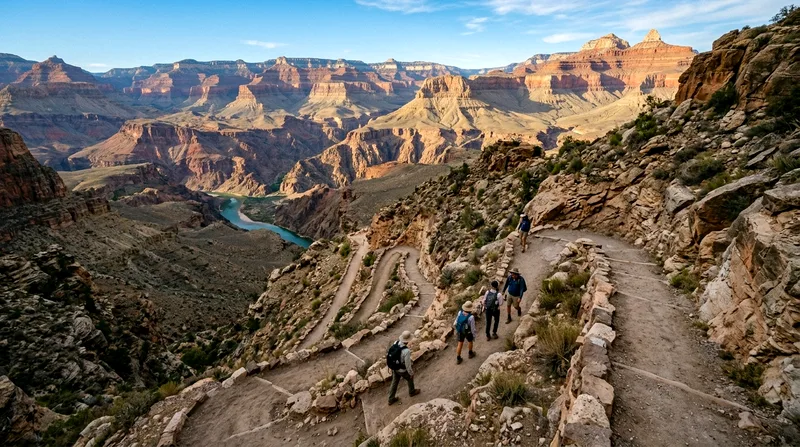
Bright Angel Trail starts near Grand Canyon Village and descends through a series of switchbacks carved into the rock. The first obvious turnaround point for casual hikers is Mile-and-a-Half Resthouse — as the name suggests, it's 1.5 miles down, with a covered rest area, seasonal water (May through September typically), and restrooms. Round trip, that's 3 miles with roughly 1,100 feet of elevation gain on the return — noticeably more strenuous than anything on the Rim Trail, but manageable for a reasonably fit beginner with good shoes and water. A gentler option is the first 0.5 to 1 mile to the first tunnel and the initial switchbacks, which gives you canyon-wall views and a sense of scale without committing to the full climb back up. Families with kids under 10 should seriously consider stopping here rather than pushing to Mile-and-a-Half.
South Kaibab to Ooh Aah Point
South Kaibab Trail is steeper and has no shade or water anywhere on it, but the payoff comes fast: Ooh Aah Point is just 0.9 miles from the trailhead, with about 600 feet of elevation gain one-way. It's a genuinely steep climb back out — don't let the short distance fool you — but it delivers one of the best panoramic views in the park for a fraction of the effort of going further to Cedar Ridge (1.5 miles) or Skeleton Point (3 miles). Because there's no shuttle parking at the South Kaibab Trailhead (it's shuttle-only, accessed via the Hikers' Express or Orange Route), you'll need to plan around bus schedules rather than driving there directly. Go early — by 9am in summer, the exposed trail is already uncomfortably hot.
Planning Your Easy Hike
A short hike doesn't mean a risk-free one. The Grand Canyon's elevation (around 7,000 feet on the South Rim) and dry air catch people out, even on trails they'd consider trivial back home. European travelers especially tend to underestimate how fast the desert air pulls moisture out of you — there's no humidity cue telling your body to drink.
Water, weather, and safety
Bring more water than feels necessary — a minimum of 1 liter per person for anything beyond a short Rim Trail walk, more if it's below-rim or summer. Water stations exist at the Visitor Center, Grand Canyon Village, and seasonally at Mile-and-a-Half and Three-Mile Resthouses on Bright Angel Trail (May to September, weather dependent — they do occasionally run dry or shut off early in the season, so don't rely on them as your only source). South Kaibab has zero water sources anywhere on the trail, which is exactly why it's less forgiving despite being shorter. Sun exposure is constant on both below-rim trails; a hat and sunscreen aren't optional extras, they're baseline gear. Watch for mule trains on Bright Angel — yield the inside trail edge and wait for them to pass.
Best seasons for beginners
Spring (April-May) and fall (September-October) are the sweet spot — daytime temperatures in the 60s to low 80s°F on the rim, far cooler than summer's regular 100°F+ readings in the inner canyon. Summer is workable for Rim Trail walking (it's exposed but short), but below-rim hikes become genuinely risky by mid-morning. Winter brings ice and snow to shaded sections of the Rim Trail and the upper switchbacks of Bright Angel — not dangerous if you're careful, but bring traction devices if you're hiking December through February. Compare this to Sedona or Horseshoe Bend, both at lower elevation and hotter for more of the year — Grand Canyon's rim is genuinely more comfortable in summer than either.
Guided Tours for Beginners
If you'd rather not navigate trail choices and shuttle schedules yourself, guided options take that decision-making off your plate entirely — useful for solo travelers wanting company, seniors wanting a measured pace, or families who want a narrator for the geology and history rather than reading interpretive signs themselves.
Ranger-led walks and group options
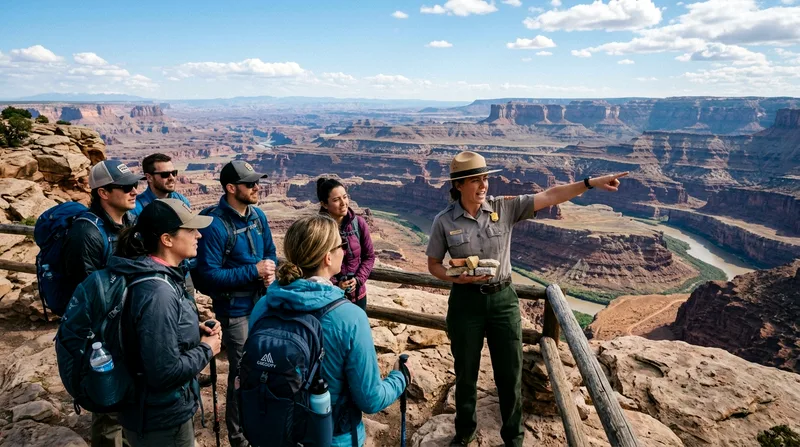
The National Park Service runs free ranger-led walks seasonally, typically covering sections of the Rim Trail or stops along the Trail of Time — an interpretive walking trail near the Yavapai Geology Museum that marks geological eras with displays explaining the canyon's rock layers, genuinely worth doing with kids curious about how old everything is. Check the visitor center schedule board on arrival since ranger programs shift throughout the year and aren't bookable in advance.
Beyond free ranger programs, small-group guided walking tours and mule-free rim excursions are bookable through the park's authorized tour providers — worth it if you want a guide handling logistics, pacing, and commentary. For something quieter than the main viewpoints, Shoshone Point is a lesser-known detour off Desert View Drive — a 1-mile round trip on a dirt road (not paved, but flat and easy) leading to a viewpoint with far fewer crowds than Mather or Yavapai Point. It's not signed from the main road, so check current access details and any seasonal restrictions before you go. If a guided option appeals to you, compare current tour prices and availability when booking, since offerings and schedules change by season.
Frequently asked questions
What is the easiest hike in Grand Canyon?
The paved Rim Trail segment between Mather Point and Yavapai Point is the easiest — about 1 mile round trip with almost no elevation change, accessible by wheelchair or stroller, and served by the free shuttle at both ends so you're never far from a bail-out point.
Are there easy hikes suitable for families and seniors?
Yes — the Rim Trail is the best choice for both groups since it's flat, paved, shaded in sections, and dotted with benches and shuttle stops. For families wanting a below-rim taste, the first half-mile of Bright Angel Trail to the initial tunnel gives a short, manageable descent without committing to the full climb back out.
How long does the Rim Trail take?
It depends which stretch you walk. A 1-mile segment takes 30-40 minutes with photo stops; the full 13-mile route from South Kaibab Trailhead to Hermits Rest would take most people 5-7 hours walking steadily, though almost nobody does it all in one go — use the shuttle to break it into sections instead.
Can beginners hike the Bright Angel Trail?
Beginners can hike the first mile or so comfortably, but the full trail to Indian Garden or the river is a strenuous multi-hour descent with a brutal climb back out — not for first-timers. Set a turnaround point (the first tunnel or Mile-and-a-Half Resthouse) before you start and stick to it regardless of how good you feel going down.
Where can I find water on easy Grand Canyon hikes?
The Rim Trail has water fountains at the Visitor Center, Grand Canyon Village, and a few other developed stops. Bright Angel Trail has seasonal water at Mile-and-a-Half and Three-Mile Resthouses, typically running May through September, but it can fail early in dry years. South Kaibab Trail has no water anywhere — carry everything you'll need before starting.