Essential guide to Grand Canyon for Europeans: flights, visa rules, car hire, tipping norms, and which tours to pre-book before your trip.
Getting to Grand Canyon from Europe
Grand Canyon for Europeans starts with an honest fact: there's no direct flight from anywhere in Europe to the canyon itself. The nearest sizeable airport is Phoenix Sky Harbor International Airport, about a 3.5 to 4-hour drive to the South Rim, or you fly into Las Vegas and drive roughly 4.5 to 5 hours. Both routes work, but they involve different trade-offs worth weighing before you book flights.
Las Vegas gives you more direct flight options from European hubs like London, Frankfurt, and Paris, plus the novelty of a stopover in a city built for excess. Phoenix tends to have fewer direct European routes but often shorter driving times to the South Rim and a calmer base if you're not interested in casinos. A third option, flying into Flagstaff via a connection, rarely makes sense for Europeans unless you're already routing through another US city—the flights are infrequent and pricier per mile than just driving from Phoenix or Vegas.
Phoenix offers the shortest drive to the South Rim, while Las Vegas offers more direct European flights but a longer road trip.
Grand Canyon for Europeans: comparing gateway cities and access routes
| Gateway | Flight from Europe (direct?) | Drive to South Rim | Best for |
|---|---|---|---|
| Las Vegas (LAS) | Yes, many European hubs | Approx. 4.5–5 hrs | Flight choice, nightlife add-on |
| Phoenix (PHX) | Limited, often one stop | Approx. 3.5–4 hrs | Shorter drive, quieter base |
| Flagstaff (FLG) | No, connects via US hub | Approx. 1.5 hrs | Overnight stop, not a gateway |
| Williams, AZ | No, drive-in only | Approx. 1 hr (plus train option) | Scenic train to park, small-town base |
Driving times are approximate and vary with traffic, season, and weather closures, so check conditions before travel.
Flight routes and gateways
From the UK, expect around 10 to 11 hours direct to Las Vegas from London Heathrow, or a one-stop route via a US hub (Dallas, Chicago, Denver) if flying to Phoenix, typically 12 to 14 hours total. From mainland Europe—Frankfurt, Amsterdam, Paris—add another hour or two depending on connections. There is no budget-carrier shortcut here; this is a long-haul flight regardless of how you slice it, so factor jet lag into your first day and don't plan a canyon hike immediately after landing.
Flagstaff works as a quieter overnight base about 90 minutes from the South Rim, and it avoids the casino noise of Vegas if you want an early start. I'd skip trying to see the canyon as a long day trip from Vegas—it's technically possible, but you'll spend more hours in the car than at the rim.
Best times to book and travel
Book flights three to six months ahead for the best fares, particularly if travelling June through September when American school holidays push prices up and park crowds peak. Shoulder seasons—April/May and September/October—offer calmer trails, milder temperatures, and noticeably cheaper flights from Europe. Winter (December–February) is the quietest and cheapest time to fly in, but the North Rim closes entirely from mid-October to mid-May, so your only option then is the South Rim.
Driving and Car Hire Essentials
A car is close to essential for visiting Grand Canyon from Europe. There's no train service to the park, and bus options from Flagstaff or Williams run on limited schedules that don't suit a flexible itinerary. Renting a car gives you control over timing for sunrise at Hermits Rest or a sunset viewpoint, which scheduled shuttles simply won't accommodate.
Renting a car as a European
Most major US rental companies accept a valid European driving licence alongside your passport, but an International Driving Permit (IDP) is recommended and sometimes required depending on the rental agency and the issuing country of your licence—check before you fly, since policies vary by company and state. Minimum rental age is typically 21, though drivers under 25 usually pay a "young driver surcharge," often $25–$35 per day. Automatic transmission is standard in the US, which suits most Europeans fine, but double-check your booking specifies automatic if that matters to you, since manual options are rare and sometimes mislabelled online.
One thing that catches Europeans out: driving on the right feels manageable within an hour, but four-way stop intersections and right-turns-on-red rules don't exist in most of Europe and trip people up in small towns like Williams or Tusayan. Fuel is cheaper than in Europe but credit card "holds" at the pump (often $100–$125) are standard and release after a few days—don't panic if your balance looks odd.
Road distances and driving times
From Las Vegas to Grand Canyon Village on the South Rim: about 280 miles, 4.5–5 hours via Highway 93/40. From Phoenix: roughly 230 miles, 3.5–4 hours. Flagstaff to the South Rim is a short 80 miles, about 1.5 hours, making it the most practical overnight stop. The North Rim sits about 220 miles from the South Rim by road—roughly 4.5–5 hours driving around the canyon—despite the two rims being only 10 miles apart as the raven flies. This single fact surprises more Europeans than anything else: you cannot casually visit both rims in one day.
Understanding US Tipping Culture
Tipping trips up more European visitors than any driving rule. In much of Europe, tipping is a rounding-up gesture; in the US, it's effectively part of the wage structure for service workers, and skipping it is noticed and genuinely resented, not just mildly odd.
Where and how much to tip
Restaurant servers expect 18–20% of the pre-tax bill for table service; 15% is considered low but acceptable only for mediocre service. Bartenders expect $1–2 per drink. Hotel housekeeping, often skipped by Europeans entirely, should get $2–5 per night left in the room. Shuttle and tour drivers typically receive $5–10 per person for a half-day tour, more for full-day or multi-stop trips. Taxi and rideshare drivers get 15–20% if paying by card, which usually prompts a tip screen anyway.
Tipping at restaurants and tours
At counter-service spots inside the park—like the cafeterias near Grand Canyon Village—tipping isn't expected unless you're ordering table service, though a jar on the counter is optional and modest, maybe a dollar or two. For organized tours, whether a mule ride, rafting excursion, or jeep tour from Tusayan, tip the guide directly in cash at the end: $10–20 per person for a half-day is standard, scaling with group size and tour length. Don't assume tip is baked into the tour price—it almost never is, and guides rely on it.
Tours and Activities to Pre-Book
Grand Canyon National Park doesn't require advance tickets for general entry—the park pass, around $35 per vehicle, is bought at the gate or online and covers seven days. But several specific experiences do need booking well ahead, sometimes months, and this is where Europeans on a fixed two-week itinerary most often get caught out.
Guided tours worth reserving ahead
Helicopter tours over the canyon, often departing from Tusayan or Las Vegas, are the single most popular pre-book item for European visitors, and the good operators sell out days or weeks ahead during peak season (June–August). Expect flights of 25–45 minutes running from roughly $200–$400 per person depending on route and whether it includes a Colorado River landing. Mule rides into the canyon from the South Rim are even more constrained—reservations open up to 13 months in advance and fill almost immediately for peak dates, so if that's a priority, book it before your flights. Colorado River rafting trips, whether a half-day smooth-water float or a multi-day whitewater trip, also need advance reservation, particularly the longer trips which can book out a year ahead. Compare current helicopter and rafting tour availability and prices before you lock in your travel dates, since options shift season to season.
Rim walks and hiking options
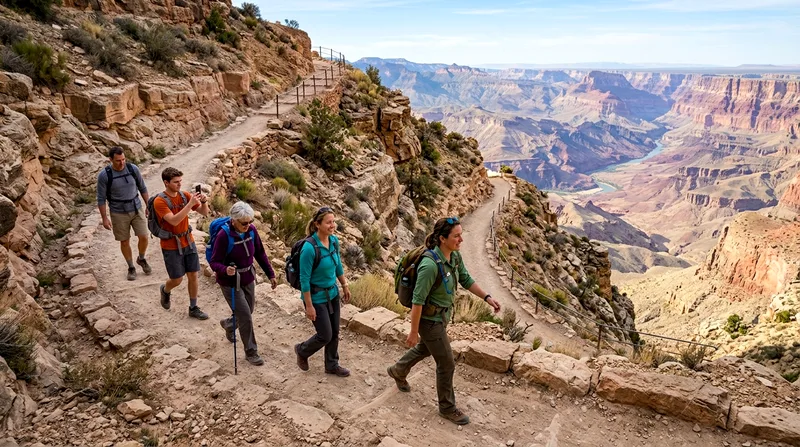
The Rim Trail along the South Rim is flat, paved in sections, and needs no booking—it's the easiest way to see multiple viewpoints including Hermits Rest without committing to a descent into the canyon. For something more serious, Bright Angel Trail is the classic choice: well-maintained, with rest houses at 1.5 and 3 miles, but genuinely strenuous on the return climb, gaining around 3,000 feet if you go as far as Indian Garden. Don't attempt a rim-to-river-to-rim hike in a single day—rangers report rescues every year from people, often fit Europeans used to Alpine trails, who underestimate the heat and the climb back out. This isn't Zion's Angels Landing, where the exposure is the main risk; here it's heat and distance that get people.
Practical Tips for European Visitors
A few logistics catch Europeans off guard beyond flights and driving, and sorting them before departure saves real hassle at the park.
Currency and payment methods
Contactless card payment is widely accepted at park facilities, lodges, and restaurants in Grand Canyon Village, so you don't need much cash for purchases. You do need small bills for tipping, though—$1, $5, and $10 notes are genuinely useful, and ATMs inside the park charge withdrawal fees on top of whatever your home bank charges for foreign transactions. Tell your bank you're travelling to the US beforehand; declined cards at remote gas stations near Williams or Tusayan are a common, avoidable headache.
Weather and what to pack
The South Rim sits at about 7,000 feet elevation, meaning summer days are warm (75–85°F/24–29°C) but nights can drop into the 40s°F (single digits Celsius)—pack layers even in July. Winter brings snow and ice to the rim regularly, and some roads can close temporarily after storms. If you're hiking down toward the Colorado River, temperatures can be 20–25°F (11–14°C) hotter than the rim, which genuinely surprises visitors used to European mountain weather patterns where it cools as you descend. Sun protection matters more than Europeans expect at this elevation—bring a hat and SPF 30+ regardless of season.
Frequently asked questions
Do I need a visa to visit Grand Canyon from Europe?
Most European citizens travel under the US Visa Waiver Program using an ESTA, not a full visa. You apply online before travel, it costs around $21, and approval typically arrives within minutes to 72 hours—apply at least a few days before departure to be safe. Check that your passport is an e-passport and valid for your entire trip, since older passports without a digital chip aren't eligible for ESTA.
How long does it take to fly from Europe to Grand Canyon?
There's no direct flight to the canyon itself. Count on 10–11 hours direct to Las Vegas from London, or 12–14 hours total to Phoenix via a US connection, then add a 3.5–5 hour drive depending on your gateway city.
Can Europeans rent cars at Grand Canyon?
Yes. European driving licences are generally accepted alongside your passport, though an International Driving Permit is recommended and occasionally required—check with your chosen rental company beforehand. Minimum age is usually 21, with a young-driver surcharge common for under-25s.
What is the standard tip percentage in the United States?
For restaurant table service, 18–20% of the pre-tax bill is standard; 15% reads as a poor-service tip. Tour guides, shuttle drivers, and housekeeping all expect tips too, typically in cash, separate from any price you've already paid.
Which Grand Canyon tours should I book in advance?
Helicopter tours, mule rides into the canyon, and multi-day Colorado River rafting trips all need advance booking—mule rides especially, since reservations open 13 months out and fill fast for peak season. General park entry needs no advance ticket.