Plan a family visit to Grand Canyon South Rim. Discover kid-friendly trails, ranger programs, viewpoints, and activities for all ages.
Grand Canyon South Rim with Kids: What to Expect
The South Rim offers accessible, engaging experiences for families of all ages, from easy viewpoint walks to interactive ranger programs. Unlike the North Rim, which closes seasonally and demands a longer drive from most entry points, the South Rim stays open year-round and sits close to Flagstaff and Williams — making it the practical choice for nearly every family itinerary.
That said, I'll say this plainly: the canyon is not a padded playground. There are long stretches of trail with no guardrail between your kid and a thousand-foot drop. Families who do well here are the ones who treat the visit like a hike through dramatic terrain, not a stroll through a theme park. Once that mental shift happens, the South Rim becomes remarkably manageable — paved paths, a free shuttle system, ranger-led programs built for children, and viewpoints spaced close enough together that even a toddler's attention span survives the day.
Family-Friendly Trails and Walks on the South Rim
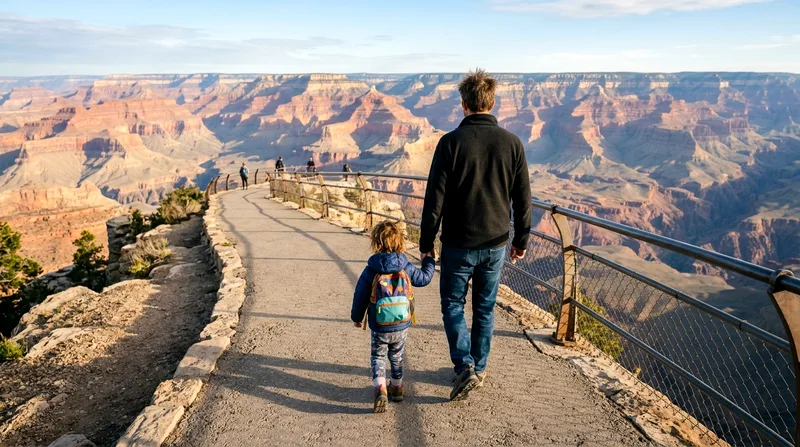
Most of what families actually walk at the South Rim is the Rim Trail — a paved, mostly flat path that runs roughly 13 miles between the South Kaibab Trailhead and Hermit's Rest, with shuttle stops along the way so nobody has to walk the whole thing. You can join it anywhere near the Grand Canyon Visitor Center and turn around whenever the kids are done. That flexibility is the trail's biggest advantage over something like Zion's Narrows or Bryce Canyon's Navajo Loop, both of which demand a real hiking commitment once you start.
I don't love recommending the Bright Angel Trail or South Kaibab Trail for young children, and I'll explain why: both drop steeply into the canyon with no shade for long stretches, and the "it's all downhill so it's easy" trap catches tired kids on the uphill return every summer. If your children are under about 10, stick to the rim.
For most families, the paved Rim Trail near the Visitor Center beats every other option for ease and reliability.
Grand Canyon South Rim with kids: trails and viewpoints compared
| Trail/Viewpoint | Surface | Distance | Best Age | Stroller-Friendly |
|---|---|---|---|---|
| Rim Trail (Mather Point to Visitor Center) | Paved | Approx. 0.5 mile | All ages | Yes |
| Rim Trail (Village to Yavapai Point) | Paved | Approx. 1 mile | All ages | Yes |
| Shoshone Point | Dirt, flat | Approx. 1 mile one-way | 5+ | Limited |
| Bright Angel Trail (to 1.5-Mile Resthouse) | Dirt, steep | Approx. 3 miles round-trip | 8+ | No |
| Hermit Road (Hopi Point to Hermit's Rest) | Mixed paved/unpaved | Varies by stop | All ages | Limited |
Distances and conditions are approximate and can shift with seasonal maintenance, so check current trail status at the Visitor Center before heading out.
Stroller-friendly and paved paths
The segment of the Rim Trail between Mather Point and the Grand Canyon Visitor Center is paved, level, and genuinely stroller-friendly — this is the stretch I'd point any family with a toddler toward first. Another solid paved section runs from the Visitor Center area toward Yavapai Point, about 1 mile one-way, with benches and shade trees at intervals. Avoid pushing a standard stroller past Hopi Point toward Hermit's Rest; the path narrows and gets uneven in spots, and a jogging-style stroller with bigger wheels handles it far better.
Short hikes for school-age children
Kids around 7 and up who want something that feels more like "real hiking" can handle the first mile of the Bright Angel Trail down to the 1.5-Mile Resthouse — though I'd cap it there and turn back, since the return climb gains roughly 1,100 feet and summer heat on the inner trail is no joke. A gentler alternative: the short walk out to Shoshone Point, a mostly flat, unpaved 1-mile path through ponderosa pine forest ending at a quiet overlook with none of the crowds you get at the main viewpoints.
Ranger Programs and Junior Ranger Activities
This is the part of the trip I'd build the day around, not treat as filler between viewpoints. The National Park Service runs a genuinely strong program here, and it costs nothing beyond park admission.
Junior Ranger program overview
The Grand Canyon Junior Ranger Program works like this: pick up an activity booklet (typically a few dollars, sometimes free depending on age group) at the Grand Canyon Visitor Center, Verkamp's Visitor Center, or Yavapai Geology Museum. Kids complete a set number of activities — identifying wildlife, answering questions about geology, attending a ranger talk — appropriate to their age bracket, usually split into groups for ages 4-7, 8-10, and 11+. Finish the booklet and a ranger swears them in and hands over an official badge. Budget 2-3 hours if you want to do it properly rather than rush it between viewpoint stops.
Educational talks and guided walks
Rangers lead free talks throughout the day at spots like the Grand Canyon Visitor Center plaza and Yavapai Geology Museum, covering condors, geology, or canyon history in 20-30 minute sessions pitched at a general audience — kids included. Check the schedule posted at the Visitor Center the morning you arrive, since times shift seasonally. These talks are a better bet for antsy kids than a formal museum tour; they're shorter, interactive, and usually end with a Q&A where rangers genuinely engage with kids' questions rather than brushing them off.
Scenic Viewpoints and Stops for Families
Spacing matters more than scenery quality when you're managing a child's patience, and the South Rim's viewpoints are laid out conveniently along the shuttle routes.
Worth seeing viewpoints for families
Mather Point, right near the Visitor Center, is the easiest first stop — flat approach, low railings in places, and usually the most crowded spot on the rim, so go early if you want elbow room. Yavapai Point has a small museum with windows facing the canyon, useful on a windy or hot day when kids need a break from direct sun. Hermit's Rest, at the far end of the Hermit Road shuttle route, has a lower-key feel and a snack stop, making it a good "last stop of the day" reward. I'd skip trying to hit every named viewpoint along Hermit Road with young kids — three or four is plenty before everyone's fried.
Photography opportunities for kids
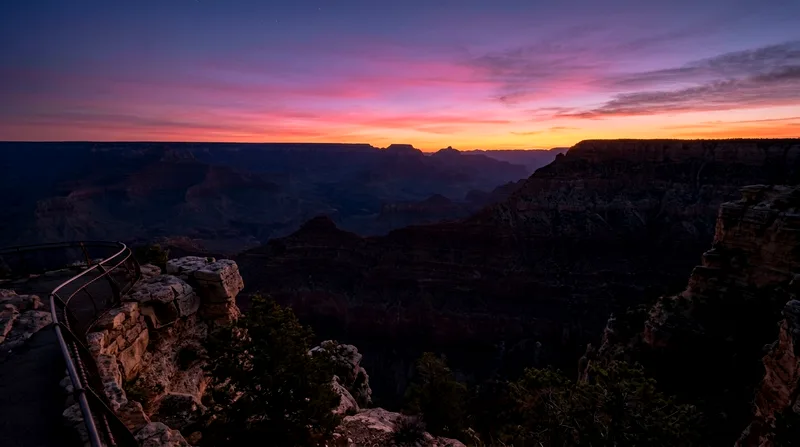
Hand a kid a cheap point-and-shoot or let them use a phone camera at Mather Point or Hopi Point — both offer wide, unobstructed views without requiring anyone to lean over a rail. Shoshone Point, mentioned above, makes a far better photo stop than the crowded main overlooks since you can actually get a clean shot without strangers in the frame. Golden hour near sunset at Hopi Point is popular for a reason, but it gets crowded — arrive at least 30 minutes early to get a spot with a clear sightline for a child's height.
Planning Your Visit to the South Rim with Kids
Good timing solves more problems at the Grand Canyon South Rim than any gear purchase will.
Best times to visit with children
Spring (April-May) and fall (September-October) bring milder temperatures and thinner crowds than peak summer, when daytime highs on the rim regularly hit the 80s-90s Fahrenheit and parking lots fill before 10am. If summer is your only window, arrive before 8am or after 4pm and plan indoor or shaded activities — the Visitor Center, Yavapai Museum — during the midday heat. Winter is underrated for families: snow dusting the rim is memorable for kids who've never seen the canyon that way, though some facilities and the Hermit Road shuttle run on reduced schedules.
How long to spend at the South Rim
One full day covers the highlights — Visitor Center, two or three viewpoints, a short rim walk, and Junior Ranger activities — but it's a packed day, not a relaxed one. Two days lets you add the Grand Canyon Railway from Williams, Arizona, a scenic train ride that kids tend to enjoy more than another hour in the car, plus time for a ranger program in the evening. Families doing the Grand Canyon as one stop on a wider Southwest loop — pairing it with Sedona, Monument Valley, or Antelope Canyon — should budget at least one full day here specifically; trying to "see" the South Rim in a two-hour drive-through stop undersells it badly.
Accessibility and Transportation Options for Families
Traffic and parking are the real friction points at the South Rim, more so than any trail difficulty.
Shuttle bus system for families
The free shuttle system runs several color-coded routes — Hermit Road, Village, and Kaibab Rim among them — connecting parking areas, viewpoints, and the Visitor Center. Buses run frequently in-season, generally every 15-30 minutes, and each has space for strollers (folded during boarding) and wheelchairs. During peak summer, private vehicles are restricted on Hermit Road entirely, so the shuttle isn't optional for that stretch — plan around it rather than fighting it.
Stroller and wheelchair accessibility
The paved sections of the Rim Trail near the Village and Visitor Center are wheelchair accessible and stroller-friendly, with curb cuts and gentle grades. Grand Canyon National Park also issues accessibility permits for visitors who need closer vehicle access to certain overlooks — worth requesting at the entrance station if someone in your group has mobility limits. Restrooms and water fill stations are spaced along the main developed areas, though they thin out fast once you're past Hopi Point, so top off water bottles at the Visitor Center before heading out.
Frequently asked questions
Is the Grand Canyon a good place to take kids?
Yes, with planning. The South Rim has paved trails, a free shuttle, ranger programs built for children, and viewpoints close enough together to keep young kids engaged. The main caution is that most overlooks have unfenced drop-offs, so supervision matters more here than at a typical family destination.
What are the best trails for kids at the South Rim?
The paved Rim Trail segments near the Grand Canyon Visitor Center and between the Village and Yavapai Point work best for young children and strollers. School-age kids who want a real hike can handle the first mile of the Bright Angel Trail to the 1.5-Mile Resthouse, turning back before the heat and climb get tough.
What is the Junior Ranger program at Grand Canyon?
It's a free National Park Service activity program where kids complete an age-appropriate booklet — covering wildlife, geology, and park history — then get sworn in by a ranger and receive an official badge. Pick up booklets at the Visitor Center, Verkamp's, or Yavapai Geology Museum; plan 2-3 hours to finish properly.
Are there stroller-friendly trails at the South Rim?
Yes. The paved stretch from Mather Point to the Grand Canyon Visitor Center and the path toward Yavapai Point are both flat and stroller-friendly. Past Hopi Point toward Hermit's Rest, surfaces get uneven, so a standard stroller struggles there.
How long do you need at the Grand Canyon with kids?
One full day covers the essentials — a couple of viewpoints, a short rim walk, and Junior Ranger activities — but it's a busy day. Two days lets you add the Grand Canyon Railway from Williams and an evening ranger talk without rushing.