Discover the worth seeing Grand Canyon South Rim viewpoints. Learn shuttle routes, guided tour options, and how to visit multiple overlooks efficiently.
What Makes South Rim Viewpoints Special
The Grand Canyon South Rim viewpoints aren't interchangeable, even though park brochures sometimes present them that way. Each overlook sits at a different point along the rim, facing a different bend of the canyon, which changes what you actually see — some face west toward the sunset glow, others look straight down at a visible stretch of the Colorado River, and a few give you miles of open eastern desert instead of tight canyon walls. Treating them as one interchangeable blur is the single biggest mistake visitors make.
South Rim elevation runs around 6,800 to 7,400 feet, and that altitude matters more than people expect. Thinner air means sunburn happens faster, short walks from parking lots feel more tiring than they should, and afternoon thunderstorms in summer roll in with little warning. Bring more water than feels necessary and don't assume a paved overlook path is effortless if you have any heart or lung condition.
Why Viewpoint Location Matters
Mather Point sits near the Grand Canyon Visitor Center, so it's the first view most people get — and it's genuinely good, but it's also the most crowded spot on the rim by mid-morning. Hopi Point and Lipan Point, both further along Hermit Road and Desert View Drive respectively, give you a wider unobstructed sweep with far fewer people blocking your shot. If you only stop at Mather Point because it's convenient, you're missing viewpoints that reward the extra ten or fifteen minutes of shuttle time.
Elevation and Visibility Factors
Visibility changes with haze, season, and time of day — on a clear winter morning you can see over 100 miles, but summer afternoon haze (sometimes worsened by distant wildfire smoke) can cut that dramatically. Yavapai Point, home to a small geology museum, sits slightly set back from the rim edge and offers one of the more reliable sightlines even when haze affects lower overlooks. If crystal-clear long-distance views matter to you, aim for early morning rather than midday.
Top-Ranked Viewpoints by Experience
Ranking by experience type works better than ranking alphabetically, because the "best" Grand Canyon South Rim viewpoint depends entirely on what you're after — a sunrise silhouette, a river glimpse, or a photo with layered rock color. Here's how the major stops actually break down.
Hopi Point wins for sunset and river framing, while Yaki Point offers a quieter sunrise with similar quality views.
Grand Canyon South Rim viewpoints compared by access, view type, and crowd level
| Viewpoint | Access | Best For | River Visible | Crowd Level |
|---|---|---|---|---|
| Mather Point | Walk from Visitor Center | First overlook, sunrise | Partial | Very high |
| Yavapai Point | Walk/shuttle | Wide views, small museum | Partial | High |
| Hopi Point | Shuttle only (seasonal) | Sunset, wide panorama | Yes | High |
| Yaki Point | Shuttle only, no private cars | Sunrise, quieter | Partial | Moderate |
| Grandview Point | Self-drive (Desert View Drive) | Photography, rock layers | No | Moderate |
| Lipan Point | Self-drive (Desert View Drive) | River views, sunset | Yes | Low-moderate |
| Desert View Watchtower | Self-drive, East Entrance | 360° views, architecture | Distant | High |
| Hermit's Rest | Shuttle only (seasonal) | End-of-route stop, history | No | Moderate |
Crowd levels and shuttle schedules vary by season; confirm current shuttle hours at the park's visitor center or website before you go.
Sunrise and Sunset Overlooks
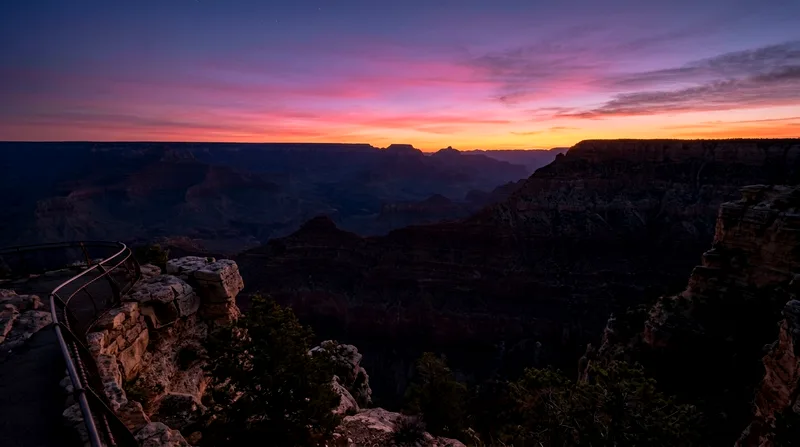
Hopi Point is the park's unofficial sunset headquarters — it juts out further than most overlooks, giving an open view in multiple directions as the light changes. Expect company; on a clear evening in high season, dozens of people line the railing. Yaki Point, reachable only by shuttle (private cars are barred from this road), is a strong sunrise alternative with noticeably thinner crowds than Mather Point at the same hour. If you want sunrise without the pre-dawn shuttle wait, Mather Point works fine too, it's just busier and less dramatic in composition than Yaki.
Colorado River Visibility Spots
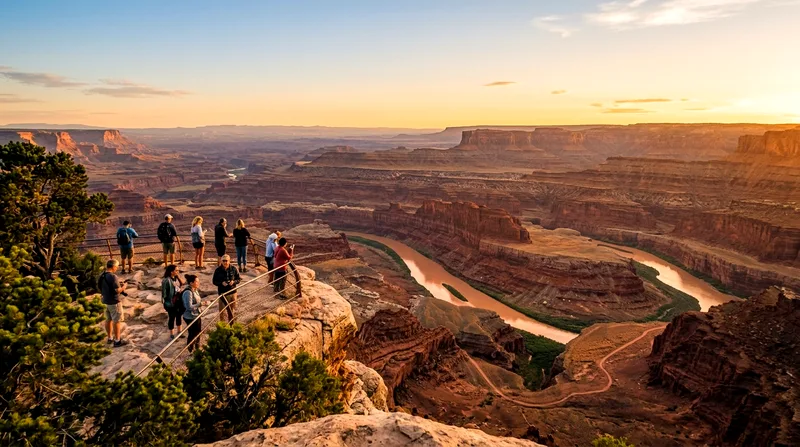
Not every viewpoint shows the river — a common surprise for first-timers. Lipan Point, out on Desert View Drive, offers one of the better river views on the South Rim, looking down onto a visible curve of rapids. Plateau Point, reached via a strenuous hike below the rim rather than a drive, gives a far closer river view but demands real hiking fitness. From the main rim-edge overlooks like Mather or Yavapai, the river is mostly hidden by inner canyon walls — don't expect a postcard river shot from every stop.
Photography and Scenic Highlights
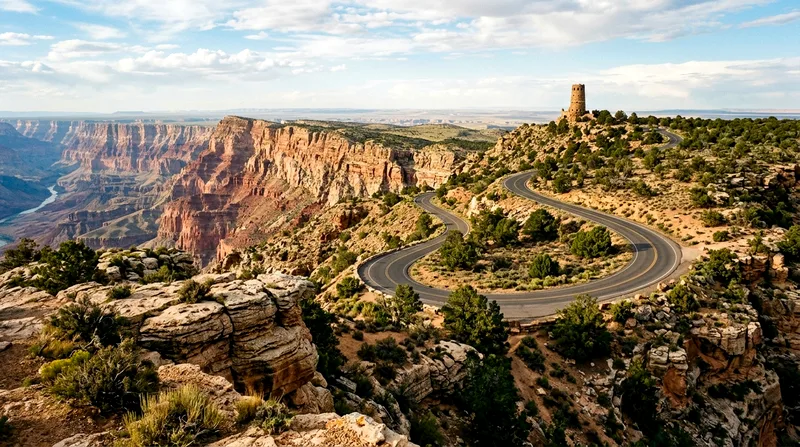
Desert View Watchtower, an 85-foot stone structure designed by architect Mary Colter and completed in 1932, is the single most photogenic man-made addition to the rim — climbing its interior stairs gives a 360-degree view that includes a distant stretch of the Colorado River. Grandview Point, with its exposed rock layers and old mining history, rewards photographers willing to walk a short way along the rim trail for a less crowded frame than Mather Point offers. Hermit's Rest, at the far end of Hermit Road, combines canyon views with a distinctive 1914 stone building and is a good last stop before heading back.
How to Visit: Shuttle vs. Self-Drive vs. Tours
This is the decision that actually determines whether your day feels smooth or frustrating. Hermit Road (home to Hopi Point, Mohave Point, and Hermit's Rest) is closed to private vehicles from roughly March through November, so during that stretch the free shuttle is mandatory, not optional. Desert View Drive, leading to Grandview Point, Lipan Point, and the Watchtower, stays open to private cars year-round, which makes self-driving a reasonable choice for that stretch specifically.
Village Route and Kaibab/Rim Shuttle Options
The park runs several free shuttle loops: the Hermit Road Route covers the Hermit Road viewpoints with about eight stops over roughly 90 minutes round trip if you don't get off; the Village Route connects the visitor center, lodges, and campgrounds; and the Kaibab/Rim Route reaches Yaki Point and the South Kaibab Trailhead, both inaccessible by private car. Buses run roughly every 15-30 minutes depending on season, more frequently at peak sunrise and sunset hours. Budget a full half-day if you want to hop off at four or five stops rather than just ride through.
Guided Viewpoint Tours and Multi-Stop Itineraries
A guided tour — whether a small-van trip or a bus tour that includes a Desert View Watchtower stop — solves the logistics problem outright: no shuttle transfers, no parking search, and a driver who knows which overlook to hit at which hour for light. The trade-off is flexibility; you stay on the group's schedule and can't linger an extra 40 minutes at Hopi Point because the light turned perfect. For visitors without a rental car, especially those arriving from Las Vegas or Phoenix on a day trip, a guided tour is often the only realistic way to cover both Hermit Road and Desert View Drive in one day. Compare current South Rim tour options and prices before you book, since itineraries and stop counts vary by operator.
Entry, Tickets, and Access
Grand Canyon National Park charges a standard per-vehicle entrance fee, typically valid for seven consecutive days — check current pricing when booking since fees are adjusted periodically. An $80 "America the Beautiful" annual pass covers entry to all US national parks and pays for itself if you're also visiting Zion or Bryce Canyon on the same trip, both of which charge separate entry fees. There's no separate ticket required for individual viewpoints — once you're in the park, Mather Point, Yavapai Point, and the rest are free to visit at any hour.
Park Entry Requirements and Passes
Entry is processed at the South Entrance gate near Tusayan or the East Entrance near Desert View — arriving via the East Entrance lets you hit Desert View Watchtower and Lipan Point first, which is a smart sequencing trick if you're driving in from Flagstaff or Sedona. No advance timed-entry reservation is required for the South Rim (unlike some shuttle-dependent sites elsewhere), though summer weekend gate lines can run 30-45 minutes.
Accessibility at Each Viewpoint
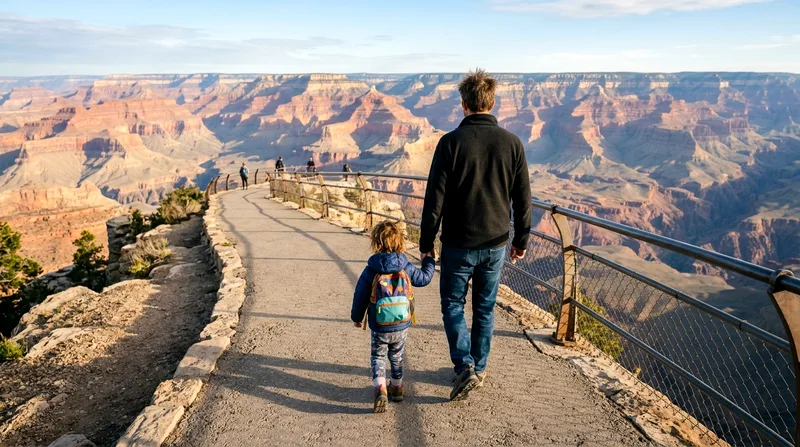
Mather Point, Yavapai Point, and the paved sections of the Rim Trail near the village are wheelchair accessible with minimal gradient. Hopi Point and Mohave Point have paved overlook areas but limited accessible parking directly at the pullout during shuttle-only months. Desert View Watchtower's ground floor is accessible, but the spiral staircase to the upper viewing levels is not. Don't assume every named overlook has a smooth path — some, like Grandview Point's connecting trail, involve uneven, unpaved ground.
Best Times to Visit Viewpoints
Timing changes everything at these overlooks, arguably more than which viewpoint you pick. A mediocre viewpoint at the right hour beats a great one at noon under flat light and a packed parking lot.
Seasonal Weather and Visibility
Winter (December-February) brings the clearest long-range visibility and the thinnest crowds, but temperatures at the rim can drop well below freezing, and some facilities on Desert View Drive reduce hours. Summer (June-August) brings monsoon thunderstorms most afternoons from mid-July onward — dramatic for photos from a safe distance, but you should leave exposed overlooks if lightning is visible. Spring and fall offer the best balance: mild days, reasonably clear skies, and lighter crowds than summer.
Crowd Patterns by Season and Time of Day
Mather Point is busy essentially all day from spring through fall because it's steps from the main parking and visitor center. Arrive before 8 a.m. or after 6 p.m. to get a clear spot at the railing. Midday — roughly 11 a.m. to 3 p.m. — is the worst window at every popular viewpoint, with tour buses arriving in waves. If you're comparing this to somewhere like Antelope Canyon, where timed-entry slots control crowding, the South Rim has no such system on its main overlooks, so showing up early is the only real crowd-avoidance strategy.
Nearby Add-Ons and Extended Experiences
If the South Rim viewpoints leave you wanting more canyon from different angles, a helicopter tour from Tusayan gives an aerial perspective that no rim overlook can match, typically running 25-45 minutes and covering a wider swath of the canyon including sections invisible from any drive-up point. Paragliding isn't permitted within the park itself, but pilots sometimes combine a canyon-area trip with flights near Sedona's red rock formations, a reasonable pairing if you're road-tripping through northern Arizona anyway.
For travelers building a bigger Southwest itinerary, the South Rim pairs naturally with Horseshoe Bend and Antelope Canyon near Page — about 2.5 hours east — or with Zion National Park and Bryce Canyon further north, both roughly a 4-5 hour drive. Don't try to cram Zion, Bryce, and the Grand Canyon into two days; each deserves at least a full day, and the drives between them are longer than they look on a map. Mule rides below the rim and the Desert View Watchtower tour are worth adding if you have an extra half-day, but skip trying to add Monument Valley unless you have at least three extra days — it's a 2.5-hour drive each way from the South Rim and feels rushed as a quick add-on.
Frequently asked questions
What is the best viewpoint on the South Rim?
There's no single "best" — it depends on purpose. Hopi Point is the strongest all-around choice for sunset and wide panoramic views, Mather Point is the most convenient first stop near the visitor center, and Lipan Point gives the clearest Colorado River visibility among the drive-up overlooks.
How do I visit multiple viewpoints efficiently?
Combine the free shuttle for Hermit Road and Kaibab/Rim stops with a self-driven run along Desert View Drive, since that road stays open to private cars. Plan for roughly 20-30 minutes per stop including walking and photos, and expect a full day if you want five or more viewpoints at a relaxed pace.
Which viewpoints offer the best sunrise and sunset views?
Yaki Point is a strong, less-crowded sunrise spot reachable only by shuttle. Hopi Point is the classic sunset location with the widest open panorama, though it draws heavy crowds on clear evenings — arrive at least 30 minutes before sunset to get a railing spot.
Can you see the Colorado River from all viewpoints?
No. Many rim-edge overlooks, including Mather Point and Yavapai Point, only show partial glimpses of the river due to inner canyon walls blocking the view. Lipan Point and the below-rim Plateau Point (reached by hiking) offer the clearest river visibility.
What shuttle routes connect the major viewpoints?
Three free routes matter most: the Hermit Road Route for Hopi Point, Mohave Point, and Hermit's Rest; the Kaibab/Rim Route for Yaki Point; and the Village Route connecting the visitor center and lodges. Buses typically run every 15-30 minutes, with increased frequency around sunrise and sunset.