Compare Grand Canyon national park pass options: vehicle, individual, annual & military passes. Pricing guidance, where to buy, and which saves money.
What is a Grand Canyon National Park Pass?
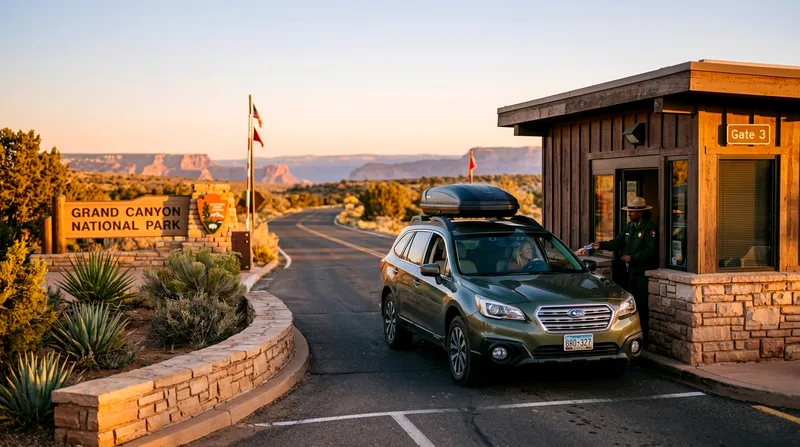
A Grand Canyon national park pass is simply the entry fee you pay to drive or walk into the park, collected by the National Park Service at staffed gates on both rims. It's not a separate add-on ticket for an attraction — it's the baseline cost of admission, similar to what you'd pay entering Zion National Park or Bryce Canyon National Park. No reservation system currently limits general entry the way timed-entry permits do at some other national parks, so the pass itself is straightforward: pay once, and it covers your party for a set number of days.
The confusion most visitors run into is thinking there's one fixed "Grand Canyon ticket." There isn't. There are several pass categories — vehicle, individual, annual, and the interagency America the Beautiful Pass — and which one makes sense depends entirely on how you're arriving and how often you plan to visit. A couple driving in for one day wants a different pass than a family doing a two-week Southwest loop through Sedona, Monument Valley, and Antelope Canyon.
Entry requirements and coverage
Every vehicle or individual entering Grand Canyon National Park needs a valid pass or receipt, checked at the entrance gate or occasionally at interior checkpoints during busy months. There's no separate pass required to see specific viewpoints like Mather Point or Desert View — general admission covers the whole park, including both rims, though they're treated as one park for entry purposes. Backcountry camping and overnight permits are handled separately through the Backcountry Information Center and are not included in any entry pass, so don't assume your vehicle pass covers a multi-day Bright Angel Trail permit — it doesn't.
Valid access points and duration
A standard entry pass is valid for seven consecutive days from the date of purchase and works at both the South Rim and North Rim entrance stations — you don't need to buy twice if you visit both during the same trip, which many people don't realize until they've already paid a second time. Keep your receipt or pass displayed on your dashboard; rangers do spot-check parked vehicles along the rim roads. If you're flying into Phoenix or Las Vegas and renting a car, the pass ties to that vehicle, not to you personally, which matters if you swap rental cars mid-trip.
Pass Types and What Each Includes
Four main categories cover nearly every visitor scenario, and picking the wrong one is usually a matter of not reading past the first price line on the NPS fee page.
Vehicle pass
The vehicle pass is the one most road-trippers want: it covers one private, non-commercial vehicle and everyone inside it, up to standard passenger vehicle capacity. It's priced per vehicle regardless of whether you've got two people or seven crammed in with camping gear. This is the default choice for families and groups arriving by car, and it's valid for seven days — plenty for a South Rim stay plus a side trip to the North Rim, which is roughly a 4.5-hour drive around the canyon rim-to-rim by car.
Individual/motorcycle pass
If you're arriving on foot, by bicycle, or on a motorcycle, you pay the individual rate per person (motorcycles are typically charged at a reduced per-vehicle rate, close to but less than the full vehicle fee). This matters for backpackers hiking in from outside the park boundary, or cyclists doing the Hermit Road in off-season when it's open to bikes. Solo hikers without a car sometimes assume walking in is free — it isn't, and rangers do check at trailhead gates near the entrance stations.
Annual pass and America the Beautiful Pass
Grand Canyon sells its own annual pass, valid for one year at that park only — a reasonable option if you live in Arizona or southern Utah and plan multiple visits. But the America the Beautiful Pass is usually the smarter buy for anyone also considering Zion, Bryce Canyon, or Yosemite in the same year: it's an annual interagency pass covering entry to every federal fee-charging site in the country, including national parks, national forests, and BLM land. It costs roughly what two single-park vehicle passes would cost, so if your itinerary includes even one more fee-charging park, it usually wins on value. Seniors (62+) can also buy a discounted lifetime or annual version — more on that below.
Military and senior discounts
Active-duty U.S. military members and their dependents get a free annual America the Beautiful Pass — available in person at the gate or participating ranger stations with valid military ID; it's not sold online for free, which trips people up. U.S. citizens or permanent residents aged 62 and older qualify for a discounted senior pass, available as an annual pass or a one-time lifetime pass, the latter being a far better deal if you're a regular park visitor over the long term. Fourth-grade students and their families can get free annual passes through the "Every Kid Outdoors" program — worth checking if you're traveling with school-age kids.
Comparing Pass Options: Cost and Value
The math here isn't complicated, but it's easy to overpay if you default to buying a day-by-day entry without checking the annual options first.
The America the Beautiful Pass beats a single-park annual pass as soon as you add a second fee-charging park to your trip.
Grand Canyon national park pass types compared by coverage and typical value
| Pass Type | Covers | Validity | Best For |
|---|---|---|---|
| Vehicle Pass | One vehicle, all occupants | 7 days | Single-trip drivers and families |
| Individual/Motorcycle Pass | One person or one motorcycle | 7 days | Hikers, cyclists, solo arrivals without a car |
| Grand Canyon Annual Pass | One vehicle, unlimited visits | 1 year, this park only | Local or frequent single-park visitors |
| America the Beautiful Pass | One vehicle, all federal fee sites | 1 year, nationwide | Multi-park road trips, repeat national park visitors |
| Senior Pass (62+) | One vehicle, all federal fee sites | 1 year or lifetime option | U.S. senior travelers, long-term frequent visitors |
| Military Pass | One vehicle, all federal fee sites | 1 year | Active-duty service members and dependents |
Prices change periodically; confirm current figures on the official NPS Grand Canyon fee page before you travel.
Day visit cost analysis
For a single one-day or even week-long visit with one car, the standard vehicle pass is nearly always cheapest — paying for an annual pass or the America the Beautiful Pass for a single trip rarely makes sense unless you're also stopping at another fee park on the same trip, like pairing Grand Canyon with Zion on a Utah-Arizona loop. Families sometimes buy individual passes per person out of habit; that's a mistake if you're all in one car — the vehicle pass covers everyone for less.
Multi-day and annual breakeven points
The breakeven point for the America the Beautiful Pass is roughly two visits to fee-charging federal sites in a 12-month period — two national parks, or one park visited twice. If you're doing the classic Southwest circuit — Grand Canyon, Zion, Bryce Canyon, maybe Monument Valley (which is tribal land and charges its own separate fee, not covered by NPS passes) — the interagency pass pays for itself before you've left Arizona. Horseshoe Bend and Antelope Canyon are also not NPS sites, so don't expect your park pass to cover those entry or tour fees either.
Where and How to Buy Your Pass
Buying ahead saves time, but it's not strictly required for most visitors — the real question is how much gate-line waiting you're willing to tolerate in peak season.
Official NPS channels and online purchase
The safest route is buying directly through the National Park Service's own site, nps.gov/grca, which links to the official fee and pass information, or through recreation.gov for certain interagency pass purchases. The America the Beautiful Pass can also be bought online through the USGS store or at any federal recreation site that sells it — REI stores in the U.S. also sell it over the counter, which is convenient if you're already gearing up for a hike. Buying online beforehand means you skip the payment step at the gate entirely; you just show your pass or confirmation.
At-gate purchase and third-party vendors
Most visitors still just pay at the entrance station — card payment is standard, and the transaction takes a couple of minutes per vehicle unless you're arriving during a holiday weekend when lines can stretch 20-30 minutes at the South Rim's main entrance. Avoid third-party travel sites that resell "Grand Canyon entry tickets" at a markup — the park doesn't need a middleman, and paying more for the same federal pass through a booking site is money wasted. If you see a tour bundle advertising "skip the line" entry fees, check exactly what's included; some shuttle and tour packages bake the entrance fee into the ticket price, which is fine, but don't buy a separate pass on top of it by mistake.
Is It Worth It? By Traveler Type
Not every visitor benefits from the same pass, and treating this as a one-size-fits-all purchase is where people waste money.
Day-trippers and casual visitors
If you're doing a single day at the South Rim — maybe as a side trip from Las Vegas or Phoenix — the standard vehicle pass is all you need. Don't let anyone talk you into an annual pass for a one-off visit; it costs more up front and you won't use the rest of its value. European travelers on a rental-car tour of the Southwest should budget the vehicle pass fee into each park stop rather than assuming one ticket covers Zion, Bryce, and Grand Canyon together — it doesn't, unless you've bought the America the Beautiful Pass specifically.
Multi-day hikers and campers
Hikers planning an overnight Rim-to-Rim trip or a multi-night backcountry permit through the Backcountry Information Center still need the standard entry pass on top of their camping permit — the two are billed separately. Since the entry pass is valid seven days, one purchase typically covers your whole hiking itinerary unless you're staying longer, in which case you'd need to renew it. Sportsmen and serious hikers doing both rims across a week-long trip get excellent value from a single seven-day vehicle pass — better value than most other pass types for that specific window.
Annual visitors and road-trippers
World travelers doing a loop through Grand Canyon, Zion, Bryce Canyon, and Yosemite in the same year should buy the America the Beautiful Pass without hesitation — it's the clear financial winner once you're hitting three or more fee sites. Senior travelers aged 62+ doing repeat Southwest trips over several years should strongly consider the lifetime senior pass instead of renewing annually; it costs more upfront but removes the question entirely for every future visit. Paragliders and helicopter tour passengers should note that air tour operators often handle any required permits separately, but general park entry for ground transport still applies to your vehicle.
Frequently asked questions
Do I need a national park pass to enter the Grand Canyon?
Yes. Every vehicle, motorcyclist, cyclist, and pedestrian entering Grand Canyon National Park through a staffed gate needs a valid pass or paid entry receipt. There's no free general admission day built into the standard calendar, aside from occasional fee-free days the NPS announces periodically — check nps.gov/grca for current dates rather than assuming one applies to your trip.
How much is a day pass at Grand Canyon National Park?
The park charges a standard per-vehicle entry fee valid for seven days, not a single day — so there's technically no separate "day pass," just the seven-day vehicle or individual pass. Prices are set by the National Park Service and adjusted periodically, so confirm the current amount on the official NPS fee page before your visit rather than relying on an older published figure.
What is the America the Beautiful Pass?
It's an annual interagency pass covering entry to all federal fee-charging recreation sites, including every national park, many national forests, and BLM land, for one vehicle and its occupants. It's sold online through the USGS store, at federal recreation sites, and at some outdoor retailers like REI. For anyone visiting two or more parks in a year — say Grand Canyon plus Zion — it usually costs less than buying separate single-park passes.
Can I get a military or senior discount on a Grand Canyon pass?
Active-duty U.S. military members and dependents receive a free annual America the Beautiful Pass, available in person with valid military ID — it's generally not issued through the online store. U.S. citizens and permanent residents 62 and older qualify for a discounted senior pass, offered as an annual version or a one-time lifetime pass, both accepted at Grand Canyon and all other federal fee sites.
Where can I buy a Grand Canyon National Park pass?
Buy directly at the South Rim or North Rim entrance stations by card, or in advance through nps.gov/grca or recreation.gov. The America the Beautiful Pass is also available at USGS online stores and some REI locations. Avoid third-party resale sites charging a markup on what is a flat federal fee — there's no benefit to paying more for the identical pass.