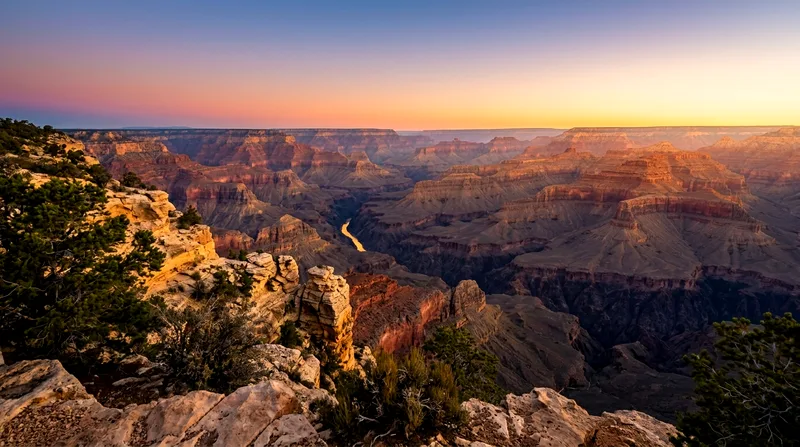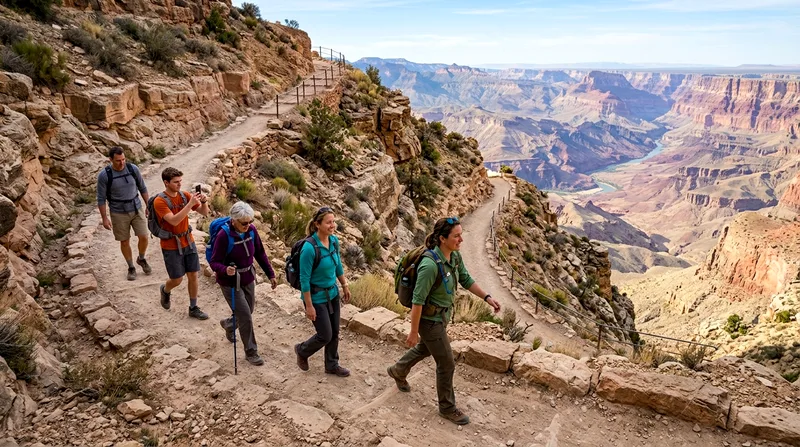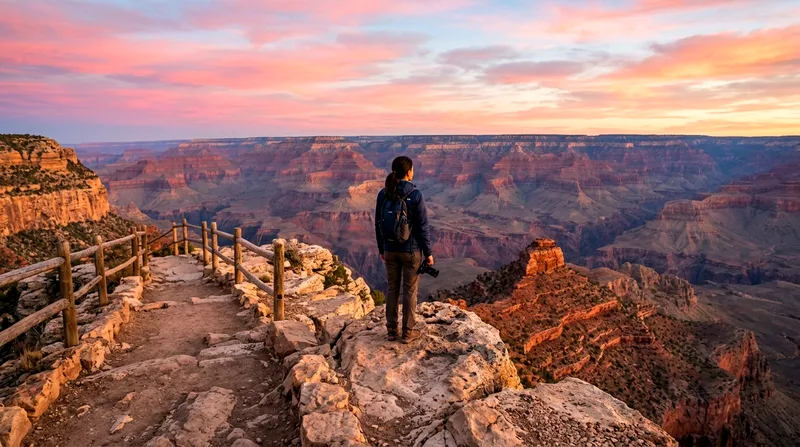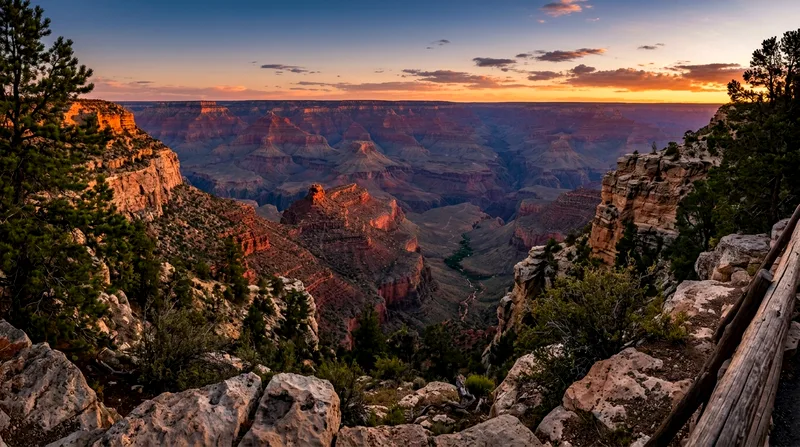
A 3-day Grand Canyon North Rim itinerary covering trails, scenic drives, mule rides, and lodging at this quieter side of the canyon.
Who This Itinerary Is For
The North Rim sits ten miles across the canyon from the South Rim as the crow flies, but it's a 220-mile, four-and-a-half-hour drive between the two developed areas. That distance filters out the day-trippers. What's left is a quieter, higher-elevation forest plateau at roughly 8,000 feet, open only from mid-May to mid-October before snow closes the main road.
This itinerary suits hikers who want trail options without fighting for parking, and couples or solo travelers looking for a slower pace than the South Rim's crowds allow. Senior travelers who prefer paved overlooks to scrambling will find Bright Angel Point and the lodge veranda deliver big views with minimal effort. European and world travelers stitching together a Southwest loop — Zion, Bryce Canyon, maybe Antelope Canyon — will find the North Rim fits naturally into that route geographically, sitting closer to southern Utah than the South Rim does.
It's not for everyone. If you've got one day in the region, go to the South Rim instead — it has the Grand Canyon Railway, more viewpoints reachable without a car, and vastly more lodging and dining choices. Families traveling with toddlers may also find the North Rim's longer trail distances between facilities frustrating; there's no equivalent to the South Rim's shuttle-linked village cluster.
Day 1: Arrival and Orientation
Treat day one as a transition day, not a hiking day. Most visitors are driving in from Kanab, Zion, or Flagstaff, and the approach itself — AZ-67 through the Kaibab National Forest — takes over an hour from the US-89A turnoff, with no gas stations along the way.
Morning: Drive and arrival
Fill your tank before leaving Jacob Lake; there's no fuel inside the park boundary at the North Rim. The drive south on AZ-67 climbs steadily through meadows and ponderosa pine forest, and it's common to see mule deer or wild turkeys along the road — slow down, especially near dawn or dusk. Plan to arrive by early afternoon so you have daylight left for orientation. Stop at the entrance station, then head straight to the visitor center near Grand Canyon Lodge to check trail conditions and pick up a park map; rangers here post current closures that don't always show up online.
Afternoon and evening: Bright Angel Point
Bright Angel Point Trail is the easiest introduction to the North Rim: a half-mile round trip from the lodge, paved for most of its length, with a narrow final stretch along a rock spine that some visitors with a fear of heights find uncomfortable. Budget 30 to 45 minutes including photo stops. It's an easy walk, but check this against the South Rim's Rim Trail, which is longer and flatter — Bright Angel Point is steeper and more exposed in short bursts. For dinner, the Grand Canyon Lodge dining room is the only sit-down option inside the park; reservations are recommended for dinner during peak summer weeks. Afterward, walk back out to the lodge's sunset porch — it's free, unticketed, and arguably the single best view-for-effort ratio anywhere on this rim.
Day 2: Rim Trails and Viewpoints
This is the day to use the North Rim's trail network properly. Start early — trailhead parking is limited (room for maybe 15-20 cars at Widforss), and afternoon thunderstorms are common in July and August.
Morning: Widforss Trail or Uncle Jim Point
Widforss Trail runs ten miles round trip through ponderosa and aspen forest to a point overlooking Haunted Canyon, but you don't need to do the whole thing — the first three miles to the Harvey Meadow area make a satisfying four-to-five-hour out-and-back with far fewer people than you'd meet on the South Rim's Bright Angel Trail. If you want something shorter, Uncle Jim Point is a five-mile round trip (about three hours) that shares its trailhead parking lot with the North Kaibab Trail and ends at a viewpoint looking down into Roaring Springs Canyon — good for spotting mule trains below. Neither trail has shade relief near the viewpoints, so carry at least two liters of water per person.
Afternoon and evening: Cape Final or Transept Trail
If your legs are tired from the morning, Cape Final is the gentler pick: a flat, four-mile round-trip walk along an old service road to one of the few east-facing viewpoints on the North Rim, which makes it a strong sunset option since you're not fighting the sun's glare on the way back. The Transept Trail is the alternative for genuinely tired legs — a 3-mile round trip connecting the campground to the lodge along the canyon rim, mostly flat, suitable even in hiking sandals. Save Cape Final for a clear evening; cloud cover there dulls the effect considerably, unlike at Bright Angel Point where even a partly overcast sky still frames the canyon well.
Day 3: Canyon Descent and Scenic Drives
Day three is for travelers comfortable with a real elevation change, followed by a long, slow scenic drive for anyone whose knees have had enough.
Each day of this North Rim itinerary balances easy rim walking against steeper trail or backcountry-road time, so pick activities matching your fitness and vehicle.
Grand Canyon North Rim itinerary: three days compared by activity, time, and difficulty
| Day | Main Activity | Time Needed | Difficulty |
|---|---|---|---|
| Day 1 | Arrival drive + Bright Angel Point | 1-2 hours walking | Easy |
| Day 2 | Widforss Trail or Uncle Jim Point | 3-5 hours | Moderate |
| Day 2 (evening) | Cape Final or Transept Trail | 1.5-2.5 hours | Easy |
| Day 3 | North Kaibab Trail (partial) | 2-4 hours | Strenuous (steep) |
| Day 3 (afternoon) | Point Sublime or Cape Royal Road | 3-4 hours driving | Easy to moderate (road quality varies) |
Typical figures based on published trail distances and elevation changes; actual times vary with fitness, weather, and road conditions.
Morning: North Kaibab Trail day hike
The North Kaibab Trail is the only maintained route from the North Rim down into the canyon, and it's steep — dropping nearly 3,000 feet over 4.7 miles to Roaring Springs. Day hikers should turn around at Supai Tunnel (1.7 miles, about 1,400 feet of descent) or Coconino Overlook (0.7 miles) rather than attempting Roaring Springs and back, which the Park Service explicitly advises against as a single-day round trip in summer heat. Start before 7 a.m.; the trail has minimal shade and temperatures rise fast once the sun clears the opposite rim. This is the North Rim's version of the South Rim's Bright Angel or South Kaibab trails, but with a fraction of the foot traffic and, notably, no water refill station as far down as Supai Tunnel in early season — confirm with rangers before relying on it.
Afternoon and evening: Point Sublime scenic drive
Point Sublime is 17 miles one-way on an unpaved, high-clearance road that takes roughly two hours each way — it's not a drive to attempt in a low sedan or after rain, when the clay surface turns to mud. If your vehicle and nerve allow it, the viewpoint is considered one of the most expansive panoramas anywhere in the park, with almost no one else there. If that's too rough, the paved alternative to Cape Royal Road covers similar canyon drama with pullouts at Walhalla Overlook and Vista Encantada, manageable in any rental car and done in about three hours round trip with stops.
Getting Around the North Rim
Unlike the South Rim, there's no free park shuttle system at the North Rim — you need a vehicle, and that changes how you plan each day here.
Vehicle access and parking
Every trailhead and viewpoint on this itinerary requires driving yourself, so budget time for backtracking rather than looping. Parking lots at popular trailheads like Widforss and Uncle Jim fill by mid-morning in July and August; arriving by 8 a.m. solves this. AZ-67, the only paved road in and out, closes for winter typically around the first significant snowfall in late fall and doesn't reopen until mid-May — check current closure dates before booking anything, since they shift year to year with snowpack.
Shuttle services and distances
The one shuttle-like option is the hikers' shuttle running from the lodge to the North Kaibab trailhead each morning in season, useful if you don't want to drive and then hike back uphill to a parking lot at the end of a long day. Distances here are longer than they look on a map — Point Sublime and Cape Royal Road sit well over an hour from the lodge, so don't plan to combine both in one afternoon.
Where to Base Yourself
Lodging options within the North Rim itself are limited to one lodge and one campground, and that scarcity drives the whole trip's planning timeline.
Grand Canyon Lodge
Grand Canyon Lodge is the only in-park accommodation, a mix of the historic main building and separate cabins set back from the rim. Rooms book out six to twelve months ahead for peak summer dates — this isn't an exaggeration for effect, it's a real planning constraint given there's nowhere else to stay inside the park. The main lodge itself has no guest rooms; all sleeping is in the cabins nearby. If you're set on staying inside the park, check availability the moment your travel dates firm up.
Nearby towns and alternatives
Jacob Lake, about 45 minutes north on AZ-67, has a lodge and a handful of cabins — a reasonable backup if the in-park lodge is full. Kanab, Utah, roughly 80 minutes away, offers more hotel inventory and makes sense if you're also visiting Zion or Bryce Canyon on the same loop. Flagstaff is too far to use as a North Rim base — it's a South Rim town, over four hours from here by road — so don't make the mistake of booking a Flagstaff hotel thinking it covers both rims conveniently.
Bookable Tours and Mule Rides
The North Rim's bookable experiences are fewer and simpler than the South Rim's helicopter-and-rafting menu, and that's part of its appeal — less to decide, less competing for your time.
Mule rides here are shorter and less crowded than the famous South Rim overnight trips to Phantom Ranch; North Rim mule rides are typically rim-edge or partial-canyon outings of one to three hours rather than multi-day descents, and they don't require the same lottery-style advance booking the South Rim's mule concession does. Still, reserve as early as you can once dates are set — slots are limited given the short operating season. A sunset-focused rim walk with a ranger, when offered, is worth checking at the visitor center on arrival; it's free and gives context you won't get reading trail signs alone.
For hikers who'd rather skip guided options, the self-guided day hikes already covered — Widforss, Uncle Jim, North Kaibab to Supai Tunnel — cover the same ground a tour would, with more flexibility. I'd skip any temptation to drive all the way to the South Rim for a helicopter tour and back in the same trip; the drive alone eats most of a day, and South Rim helicopter operators generally don't fly North Rim routes anyway. If flight-seeing matters to you, build it into a separate South Rim leg of your trip instead. Compare current North Rim tour and mule ride options and prices before you book, since availability shifts through the season.
Frequently asked questions
What are the best hiking trails at the North Rim?
Widforss Trail (up to 10 miles round trip through forest to a canyon viewpoint) and the North Kaibab Trail (steep, descending toward Roaring Springs) are the standouts. For easier walks, Bright Angel Point (0.5 miles) and Transept Trail (3 miles, mostly flat) suit tired legs or limited time.
How many days do you need at the North Rim?
Three days covers the main trails, viewpoints, and at least one scenic drive without rushing. Two days works if you skip the North Kaibab descent or the Point Sublime drive. One day only allows time for Bright Angel Point and one short trail — not enough to justify the long drive in for most travelers.
What tours and mule rides are available?
North Rim mule rides run shorter rim-edge and partial-canyon routes, typically one to three hours, with less advance lottery pressure than the South Rim's overnight trips. Ranger-led walks are sometimes offered free at the visitor center. There's no helicopter touring based at the North Rim itself.
Where can you stay at the North Rim?
Grand Canyon Lodge is the only in-park option and books out many months ahead for summer. Jacob Lake (about 45 minutes away) and Kanab, Utah (about 80 minutes) are the practical backups with more room inventory.
Can you combine North Rim with Zion and Bryce Canyon?
Yes, and it's a natural pairing — Zion is roughly two and a half hours from the North Rim, Bryce Canyon about three hours, both closer than the South Rim. A common route links Zion, Bryce, and the North Rim over seven to ten days, often adding Antelope Canyon or Horseshoe Bend nearby in Page, Arizona.